





How Manufacturers Can Upskill Machinists into Automation Technicians
The manufacturing industry in 2026 is facing a major challenge. The demand for automation technicians continues to grow, with the Bureau of Labor Statistics projecting 13% growth for industrial machinery mechanics and maintenance workers through 2032. At the same time, there are not enough qualified candidates to fill those roles. This gap is driving increased focus on how agencies facilitate upskilling for process and manufacturing workers to help manufacturers build talent from within rather than relying solely on external hiring.
However, many companies already have strong potential candidates on their shop floors. Experienced machinists already understand materials, tolerances, and how machines operate. Instead of relying only on outside hiring, manufacturers should invest in training the employees they already have.
Upskilling machinists into automation technicians is more than just a positive HR initiative. It is becoming necessary for long-term success. Companies that invest in their current workforce can retain valuable knowledge, lower hiring costs, and build teams that understand both traditional machining and modern automation technology.
Companies that fail to adapt will continue competing for a limited talent pool while others move ahead. The key is creating a practical training program and measuring results that actually matter.
The manufacturers that will lead the next decade are not just investing in automation technology; they’re investing in the people who already understand how production truly works. Some of the best future automation technicians are sitting on manufacturing floors today as machinists with years of hands-on problem-solving experience. Organizations that create intentional upskilling pathways will build stronger retention, preserve institutional knowledge, and gain a significant competitive advantage in an increasingly technical labor market.
-Vice President, Georgianna Rhoda
The Evolution of Machinist Automation in Modern Manufacturing
The relationship between machinists and automation has changed significantly over the past decade.
The line between manual operators and controls engineers is no longer clear. They now work within connected systems that combine CNC machines, robotic arms, vision systems, and sensors.
This shift has created workflows that require a broader mix of skills, not just one area of expertise.
Bridging the Gap Between Manual Operation and Robotics
Most machinists already work with automation in some form. They program CNC machines, adjust feeds and speeds, and troubleshoot problems when they come up.
Moving into a full automation technician role isn’t a huge leap, but it does require new training. Key areas include robot programming, network communication, and system-level troubleshooting.
The main gap isn’t mechanical skill. It’s digital literacy and systems thinking.
A machinist may know why a part is out of spec, but an automation technician also needs to understand why the robot loading that part is failing, why a sensor isn’t triggering, and how the PLC connects everything.
The goal is to build on existing experience, not start over.
Identifying Core Competencies for the Automation Transition
Not every machinist will make a great automation technician, and that’s fine. The ones who thrive tend to share a few traits: curiosity about how systems interact, comfort with troubleshooting under pressure, and a willingness to learn software tools. Before launching any training program, manufacturers should assess their machinists across these competencies:
- Mechanical reasoning and spatial awareness (already strong in most machinists)
- Basic electrical knowledge, including reading wiring diagrams
- Familiarity with G-code and CNC programming logic
- Problem-solving approach: do they isolate variables systematically?
- Comfort level with computer interfaces and software tools
A skills gap analysis doesn’t need to be complicated. A structured assessment paired with supervisor input will identify your strongest internal candidates quickly.
Designing a Structured Upskilling Roadmap for Internal Talent
The biggest mistake manufacturers make is treating upskilling as a one-off training event. A two-day seminar on robotics won’t turn a machinist into an automation technician any more than a weekend cooking class turns someone into a chef. You need a phased roadmap that builds competency over months, not days.
From CNC Programming to PLC Logic and Sensor Integration
The natural progression starts with what machinists already know: CNC programming. From there, the path moves into programmable logic controllers (PLCs), which are the brains behind most automated systems. Allen-Bradley and Siemens platforms dominate North American manufacturing, so training should focus on at least one of these ecosystems.
A practical 12-month roadmap might look like this.
Months one through three cover PLC fundamentals and ladder logic programming. Months four through six introduce sensor types, I/O configuration, and basic HMI design.
Months seven through nine focus on integration, including connecting PLCs to robots, conveyors, and vision systems. The final quarter involves supervised, independent troubleshooting on live production equipment.
Each phase should include both classroom instruction and hands-on application.
Hands-on Training with Collaborative Robots (Cobots)
Cobots have become the ideal training platform for transitioning machinists. Unlike traditional industrial robots that require safety caging and extensive programming knowledge, cobots from manufacturers like Universal Robots and FANUC’s CRX series are designed for direct human interaction. They’re forgiving, relatively intuitive, and increasingly common on production floors.
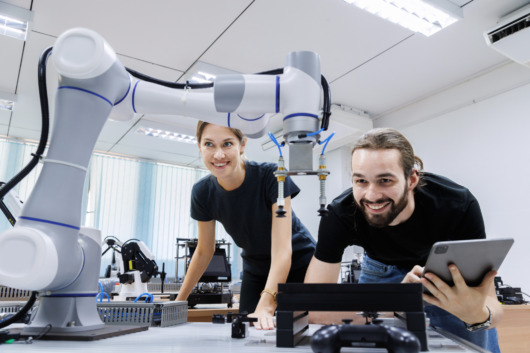
Setting up a dedicated training cell – even a small one – gives machinists a safe environment to experiment. They can learn waypoint programming, force sensing, and basic pick-and-place routines without risking production equipment. Several manufacturers I’ve seen succeed with this approach dedicate just 200 square feet of floor space and a single cobot to create an effective learning lab. The investment typically runs between $40,000 and $75,000, which is a fraction of what external hiring would cost.
Leveraging AI and Advanced Tech to Empower Manufacturing Workers
AI isn’t replacing machinists. It’s giving them superpowers – if companies deploy it correctly. The key is using AI as a training accelerator and a daily tool that makes automation technicians more effective, not as a replacement for human judgment.
Upskilling Manufacturing Workers with AI-Driven Predictive Maintenance
Predictive maintenance is one of the most practical ways to upskill manufacturing workers with AI.
Instead of running equipment until it breaks or replacing parts on a fixed schedule, AI-driven systems help prevent failures before they happen. They do this by analyzing data like vibration levels, temperature changes, and power usage trends.
This approach allows teams to catch early warning signs and act before a breakdown occurs.
Training machinists to interpret these AI outputs builds an important new skill: data-informed decision making. Many machinists already know what a failing bearing sounds like or feels like. Now they can connect that hands-on experience with sensor data and trend analysis.
Platforms like Augury and Uptake provide dashboards built for technicians, not data scientists. This makes the learning process more accessible.
Companies using predictive maintenance report 25–30% reductions in unplanned downtime, according to Deloitte’s 2025 manufacturing outlook. This makes the business case clear and compelling.
Augmented Reality (AR) as a Real-Time Training Tool
AR headsets and tablet-based apps are becoming effective tools for on-the-job training.
Instead of taking technicians off the floor for classroom training, AR shows step-by-step instructions directly on the equipment they’re working on. Devices like Microsoft HoloLens 2 and RealWear Navigator are already being used in manufacturing.
This speeds up learning. For example, a machinist wiring a sensor panel can see exactly where each connection goes in real time while keeping their hands free.
Companies report up to 40% faster training for complex tasks compared to traditional methods. AR also allows remote experts to guide technicians live by seeing what they see and walking them through the process.
How Agencies Facilitate Upskilling for Process and Manufacturing Workers
Not every manufacturer has the internal resources to build a training program from the ground up. This is where external partners become critical, and understanding how agencies facilitate upskilling for process and manufacturing workers can save months of trial and error.
Partnering with Specialized Staffing and Training Firms
Specialized staffing firms offer two key advantages most manufacturers don’t have: insight into effective training approaches and access to pre-vetted candidates already developing automation skills.
The best partners go beyond filling roles. They help build training plans, identify skill gaps, and match candidates based on aptitude, not just resumes.
A good staffing partner will also help you benchmark your training program against industry standards. If your competitors are producing competent automation technicians in nine months and your program takes eighteen, something needs to change. External perspective prevents the blind spots that develop when you only look inward.
Accessing Government Grants and Industry Certification Programs
Federal and state workforce development funds are still underused by manufacturers. Programs like Department of Labor apprenticeships, WIOA grants, and state tax credits can cover 30–60% of training costs, but many companies skip them due to paperwork.
Industry certifications help add structure. Credentials like ISA’s Certified Automation Professional (CAP) and FANUC robotics certifications give clear skill benchmarks and ensure training leads to verified competency.
Measuring Success and Retention in the Automation Era
You can’t manage what you don’t measure, and too many upskilling programs run on vibes rather than data.
Defining Key Performance Indicators for Technical Proficiency
Track metrics that actually matter. Mean time to repair (MTTR) for automated systems is a direct indicator of technician competency. Overall equipment effectiveness (OEE) improvements tied to specific technicians show who’s applying their training. Certification pass rates and training milestone completion times reveal whether your program’s pace is appropriate.
Set baselines before training begins. If your average MTTR on a robotic welding cell is 4.2 hours, you should see that number drop as newly trained technicians gain confidence. A realistic target is a 20-30% MTTR reduction within the first year of a technician completing the program.
Creating Career Pathways to Retain Newly Skilled Technicians
Here’s the uncomfortable truth: if you invest in training machinists into automation technicians and don’t give them a clear career path, your competitors will happily hire them away. Retention isn’t about pizza parties. It’s about showing people where they’re headed.
Build at least three tiers: automation technician I (entry, focused on maintenance and basic troubleshooting), automation technician II (intermediate, capable of programming and system modifications), and automation specialist or engineer (senior, involved in system design and continuous improvement). Each tier should come with defined pay increases, typically 10-15% per level, and expanded responsibilities. The National Association of Manufacturers found that companies with structured career pathways retain technical workers at rates 34% higher than those without.
Building the Workforce You Need
The manufacturers winning in 2026 aren’t those with the biggest recruiting budgets. They’re the ones turning existing machinists into future automation technicians.
Upskilling requires real investment in training, tools, and external partners. But it pays off through lower hiring costs, retained knowledge, and faster automation deployment.
If your organization is looking to build or strengthen its automation talent pipeline, Hunter Recruiting’s technical recruitment team specializes in connecting manufacturers with skilled professionals across engineering, technology, and advanced manufacturing roles. Explore current opportunities to see how the right staffing partner can support your workforce strategy.